> ## Documentation Index
> Fetch the complete documentation index at: https://www.referly.so/docs/llms.txt
> Use this file to discover all available pages before exploring further.
# Migrate from Trackdesk
> Import your affiliates, referred customers, and past sales from Trackdesk into Referly using your Trackdesk API key and tenant ID. Step-by-step guide to finding both credentials, connecting, and every field setting.
Moving from Trackdesk doesn't mean rebuilding your program by hand. Referly connects straight to your Trackdesk account and pulls your **affiliates**, their **referred customers**, and your past **sales and commissions** across for you — no CSV exports, no file wrangling. You give Referly two details from Trackdesk, choose what to bring over, and it does the rest in the background.
This guide walks through the whole move: where to find both details inside Trackdesk, how to connect, every setting you'll see while choosing what to import, and how to follow each import as it runs.
New to migrating in general? Start with the [Migration overview](/docs/help-center/getting-started/migrate/overview) for how imports work, then come back here for the Trackdesk-specific steps.
## Before you start
You'll need:
* **Admin access to your Trackdesk account**, so you can open its settings and copy your identifiers.
* **Your Referly program open** in the dashboard, ready to import into.
* A few minutes. Larger programs take longer to pull across, but the import runs in the background — you don't have to wait on the screen.
Unlike most platforms, Trackdesk needs **two** details to connect: an **API key** and a **tenant ID**. Both live in the same place in Trackdesk, so you can grab them together.
Your Trackdesk API key works like a password — it can read your account's data. Copy it straight into Referly, don't paste it into public code, screenshots, or repositories, and don't share it. Referly stores it securely so you only enter it once.
## Get your API key and tenant ID from Trackdesk
Both details live behind the same button in Trackdesk, called **Your Trackdesk identifiers**.
Sign in to your Trackdesk account as an admin.
Go to your **Settings** page.
Select **Your Trackdesk identifiers** in the top-right corner of the Settings page. A panel opens showing your identifiers, including your personal access token (your API key) and your tenant ID.
Copy your **personal access token** from that panel — this is the API key Referly asks for. If you'd rather manage tokens in one place, you can also go to **Settings → Integrations → Personal tokens** and create a new token there. Treat it like a password.
Copy your **tenant ID** from the same panel. Your tenant ID is the part of your Trackdesk web address before `.trackdesk.com` — so if you sign in at `my-program.trackdesk.com`, your tenant ID is `my-program`.
If your API key ever gets exposed, delete it in Trackdesk's **Personal tokens** section and generate a fresh one, then reconnect in Referly with the new key. Your tenant ID doesn't change.
With both copied, head back to Referly.
## Open the import tool and choose Trackdesk
In your Referly dashboard, select the **plus (+)** button in the top bar, then choose **Import Data**. You can also select **Import** from the top of your **Affiliates**, **Customers**, or **Sales** pages.
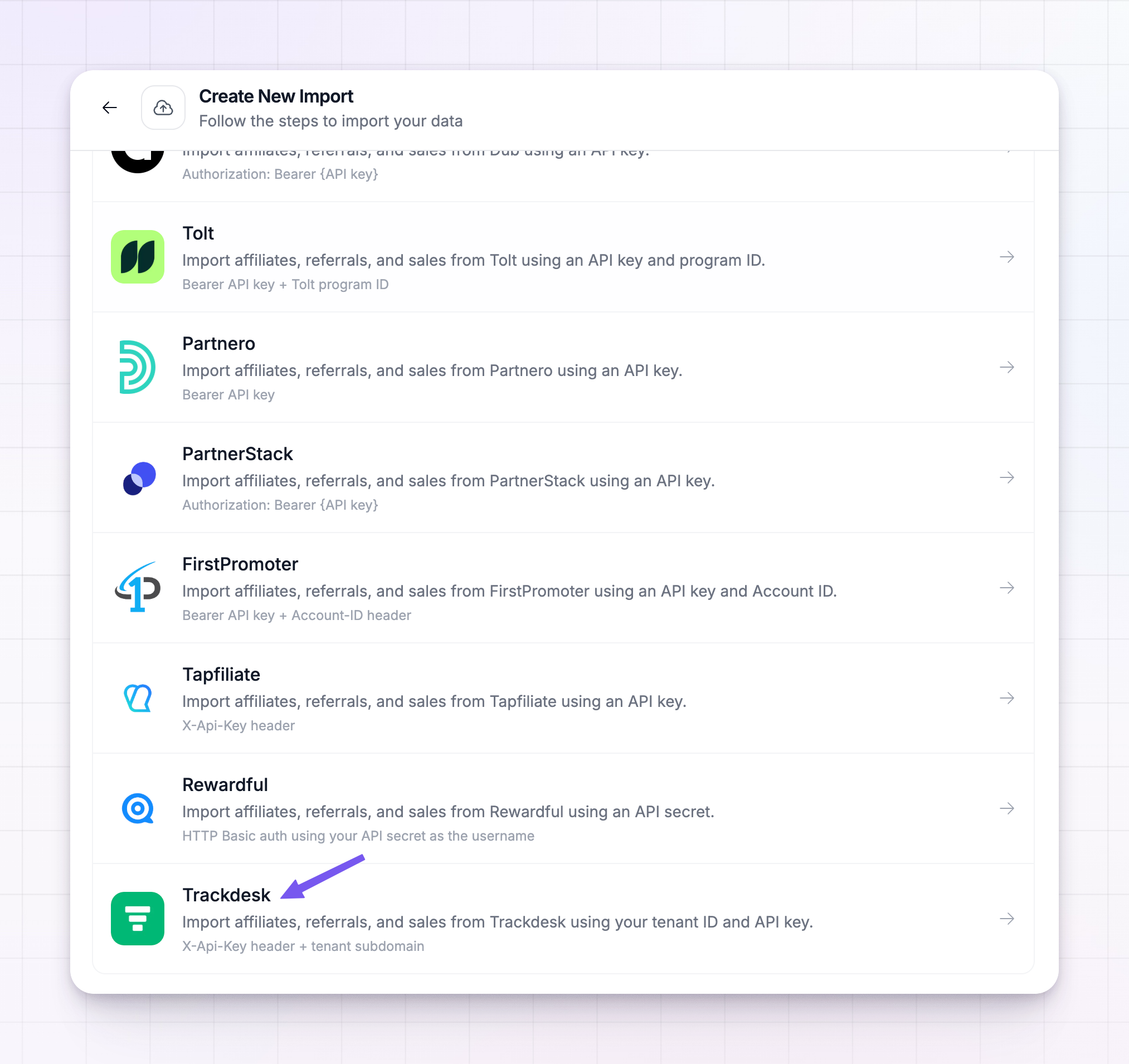
On the **Choose your source** screen, select **Trackdesk** from the list of platforms.
## Connect your Trackdesk account
The next screen shows Trackdesk connecting to Referly. Because Trackdesk needs both details, this form has two fields: **Tenant ID** and **API key**.
Type or paste your tenant ID into the **Tenant ID** field — the subdomain before `.trackdesk.com`, such as `my-program`. This is how Referly knows which Trackdesk account to read.
Paste the API key you copied from Trackdesk into the **API key** field. It's hidden as you type, the same way a password field is.
Select **Save connection**. Referly checks both details with Trackdesk right away. If they work, you'll see the connection saved with a green **Saved connection** badge. If it doesn't connect, double-check that your tenant ID is just the subdomain (no `https://` and no `.trackdesk.com`) and that you copied the whole API key, then try again.
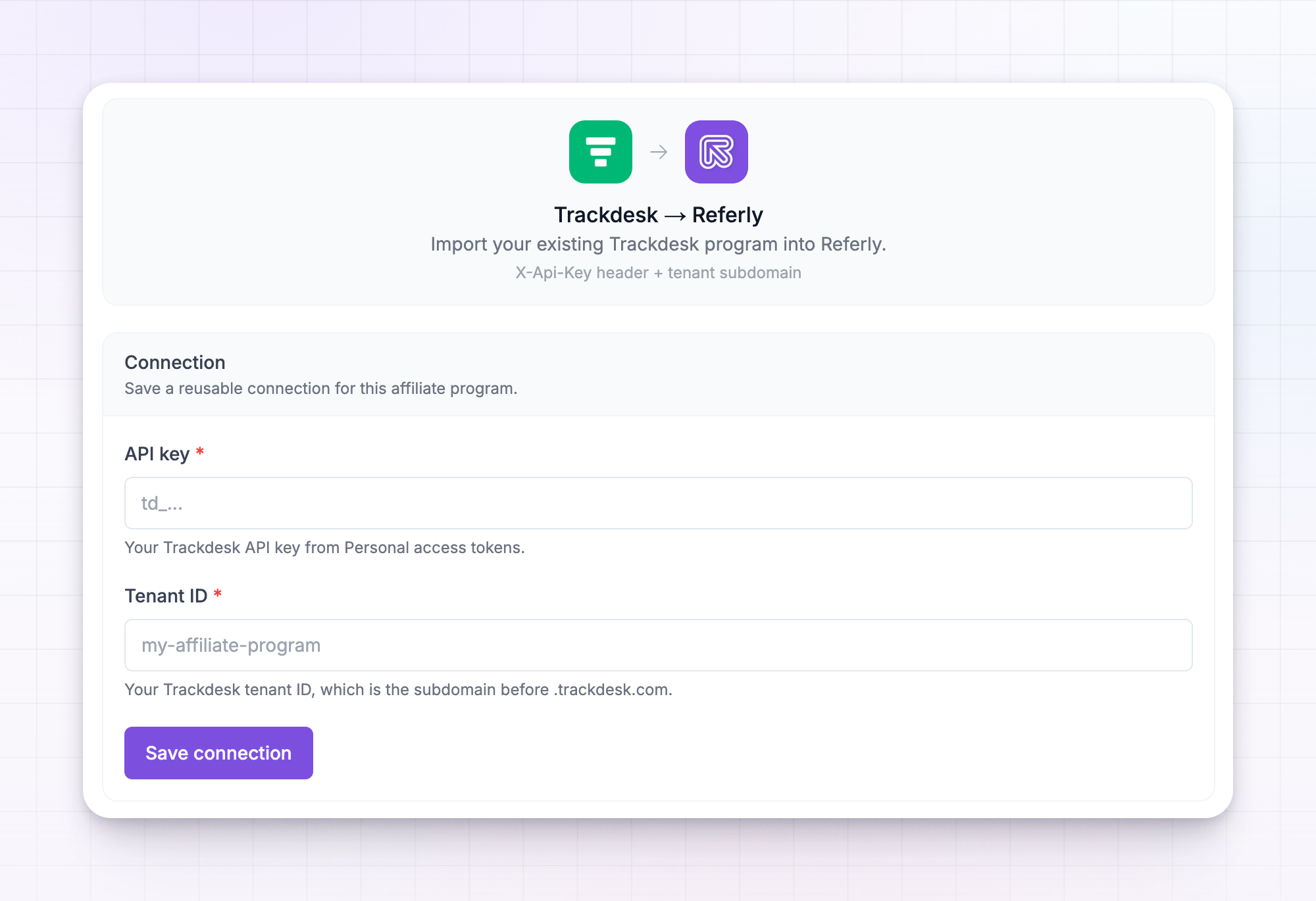
Referly remembers this connection, so the next time you import from Trackdesk — say, to bring sales across after your affiliates — you won't have to enter either detail again. To swap in a different key later, select **Replace connection**.
## Choose what to import
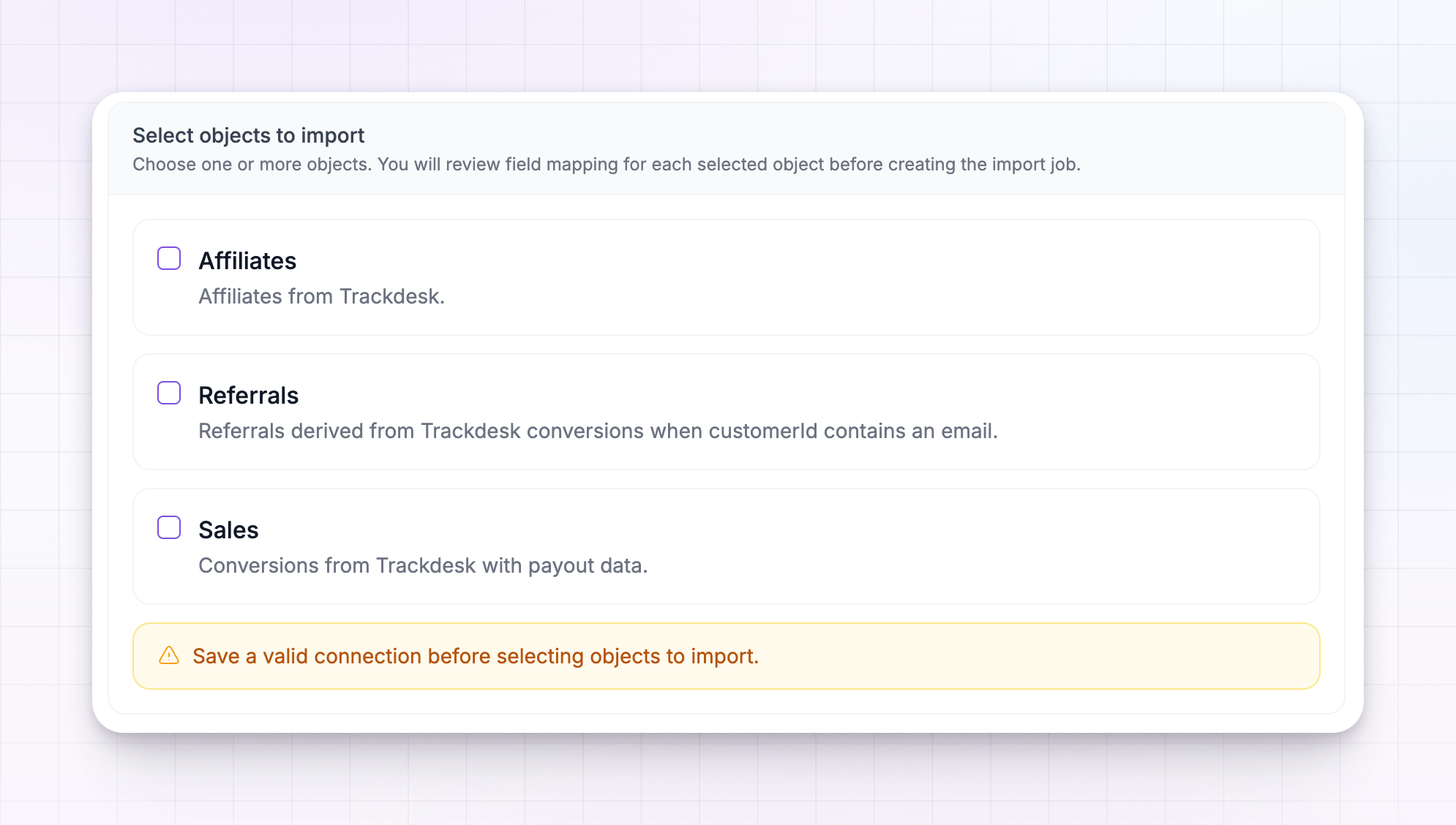
Once the connection is saved, you choose which parts of your Trackdesk program to bring over. There are three, and they line up with Trackdesk like this:
| Select this in Referly | What it brings over from Trackdesk |
| ---------------------- | -------------------------------------------------------------------------------------------------------------------------------------- |
| **Affiliates** | Your affiliates, with their names, emails, and referral IDs. |
| **Referrals** | The customers your affiliates referred, worked out from your Trackdesk conversions and linked back to the affiliate who referred them. |
| **Sales** | Your past conversions and the commissions on them, credited to the right affiliate. |
You can tick one, two, or all three — but the **order you import them matters**. Referred customers attach to affiliates, and sales attach to customers, so those have to exist in Referly first. Always bring your **affiliates over first**, then referrals, then sales. See [Import in the right order](#import-in-the-right-order) below.
### Pick the fields to bring across
When you tick an object, it expands to show every field Referly can pull from Trackdesk for it. Each field has a checkbox, so you decide exactly what comes across. A few fields are marked **Required** — these are the details Referly needs to create the record, so they're always on and can't be switched off.
Here's what you can bring for each object.
* **First name** *(required)* — the affiliate's first name.
* **Last name** *(required)* — the affiliate's last name.
* **Email** *(required)* — the affiliate's email address. This is also how Referly links their referred customers and sales back to them.
* **Join date** — when they registered in your Trackdesk program, so their history stays accurate.
* **Affiliate link** — their referral ID from Trackdesk, so their existing links carry over.
* **Provider affiliate ID** — the ID Trackdesk used for the affiliate, kept for your reference.
* **Provider status** — the affiliate's status in Trackdesk (for example, active), kept for your reference.
Trackdesk doesn't store a separate payout email for affiliates, so that field stays blank on import — your affiliates' account email carries over as their email.
* **First name** *(required)* — the customer's first name.
* **Last name** *(required)* — the customer's last name.
* **Email** *(required)* — the customer's email address.
* **Affiliate email** *(required)* — the email of the affiliate who referred them. This is how each customer gets attached to the right affiliate, which is why affiliates must be imported first.
* **Join date** — when the conversion was first recorded in Trackdesk.
* **External user ID** — the customer identifier Trackdesk had on the conversion, kept for your reference.
* **Provider customer ID** — the customer's ID in Trackdesk, kept for your reference.
* **Provider status** — the conversion's status in Trackdesk (for example, approved or pending).
* **Customer email** *(required)* — the email of the customer who bought.
* **Customer name** — the customer's name.
* **Affiliate email** — the email of the affiliate credited for the sale.
* **Transaction amount** *(required)* — the revenue value of the conversion.
* **Transaction date** — when the conversion happened.
* **Commission** *(required)* — the commission earned on that conversion.
* **Paid status** — the conversion's status in Trackdesk (for example, approved or pending), so your payout history stays right.
* **Promo code** — the coupon code used on the sale, when there was one.
* **Affiliate link** — the referral ID tied to the sale.
* **Provider transaction ID** — the conversion's ID in Trackdesk, kept for your reference.
* **Provider status** — the conversion's status in Trackdesk.
The default selections cover what most programs want, so if you're not sure, leaving them as they are is a safe choice. When you're happy with your picks, select **Continue**.
Trackdesk tracks your customers and sales as **conversions**, and it identifies each customer by whatever value you passed as the customer ID when the conversion was recorded. Referly can only bring a referred customer or their sale across when that customer ID is an **email address**. If your Trackdesk conversions use an anonymous ID instead of an email, those customers and sales are skipped — your affiliates still come across cleanly. If most of your customers have emails on file elsewhere, the [CSV import](/docs/help-center/getting-started/migrate/csv) is a good way to bring the rest in.
## Check the field matches
Before anything is imported, Referly shows you a preview of your Trackdesk data lined up against the matching Referly fields. This is your chance to confirm everything landed in the right place — that names, emails, and amounts are matched to the fields you'd expect.
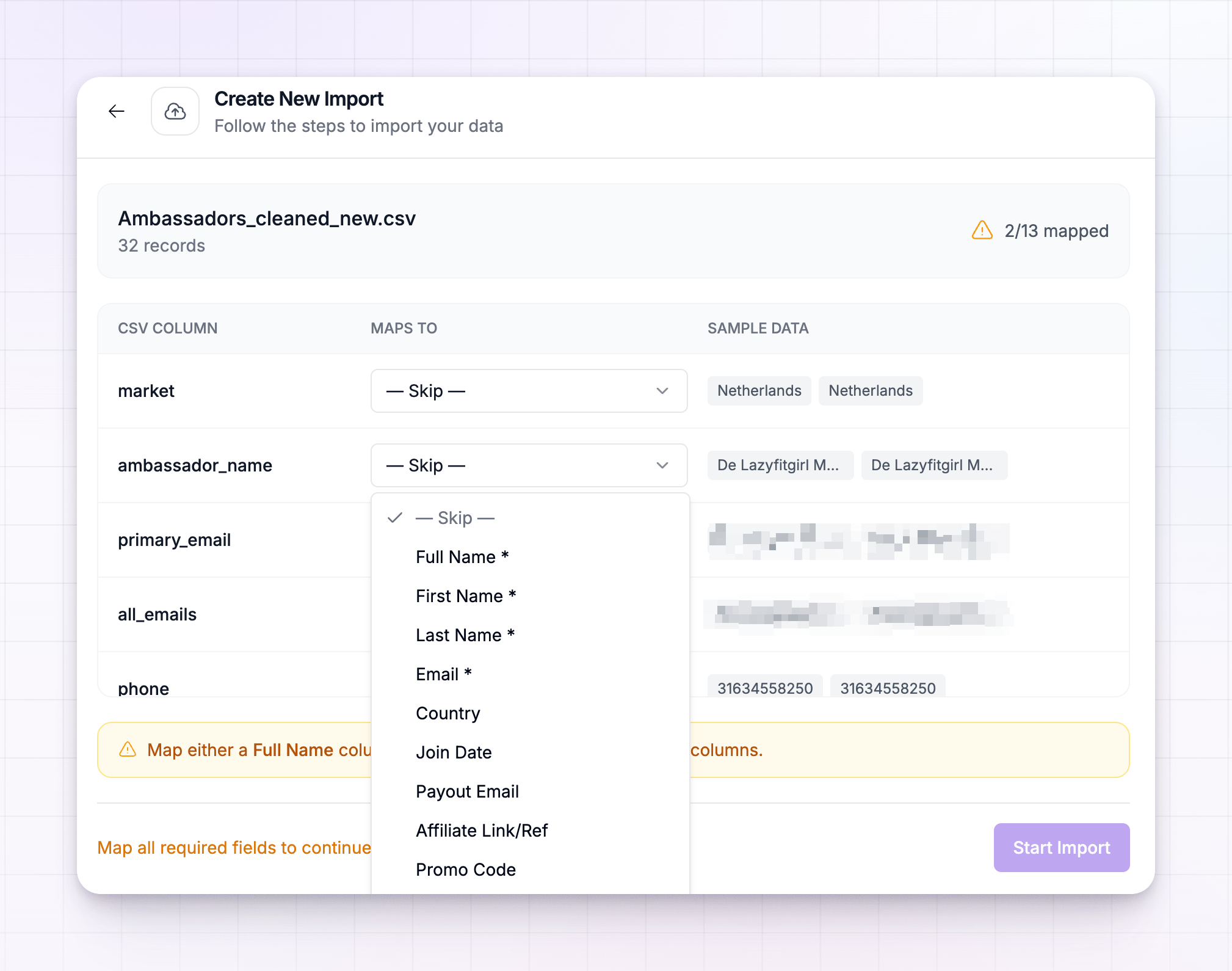
Look the preview over, and when it looks right, confirm to start the import.
## Start the import and follow its progress
Imports run in the background, so you can close the panel and keep working. Every import appears in the **Recent Imports** list inside the import tool, each with its own progress.
An import moves through these states:
| Status | What it means |
| -------------- | ------------------------------------------ |
| **Pending** | Queued and about to start. |
| **Processing** | Bringing your records in right now. |
| **Paused** | You've paused it; resume it any time. |
| **Completed** | Finished — all records handled. |
| **Failed** | The import stopped before finishing. |
| **Cancelled** | The import was stopped and won't continue. |
Each card shows a progress bar and a running count of how many records came in and how many were **skipped**. A record is skipped when it's missing a detail Referly needs to place it — most often a Trackdesk affiliate with no email, or a conversion whose customer ID isn't an email. That's normal; the skipped count just tells you those few couldn't be brought across.
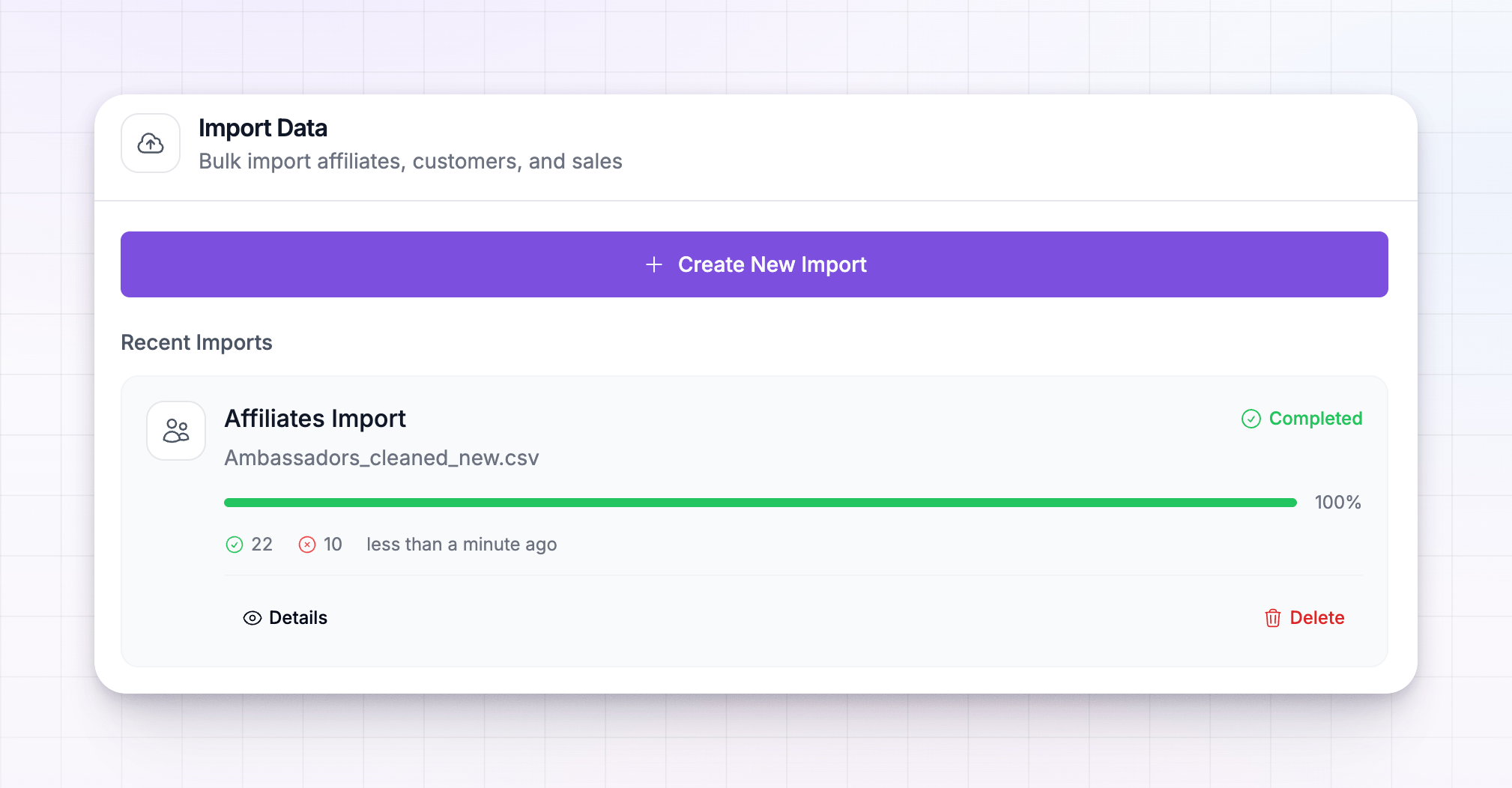
You can **pause** a running import and **resume** it later, open **Details** for the full breakdown, or **delete** one you no longer need.
## Import in the right order
Because referred customers attach to affiliates and sales attach to customers, run your Trackdesk imports in this order and let each finish before starting the next:
Bring your affiliates over so there's someone for every customer and sale to attach to.
Import your referred customers. Each one links to its affiliate by email — which only works once those affiliates are already in.
Import your conversions and commissions, credited to the affiliates and matched to their customers.
Referly reminds you of this order as you go, and it won't let you start a customer or sales import while the affiliate import it depends on is still running. Since your Trackdesk connection is saved, each round just means reopening the import tool, picking Trackdesk, and choosing the next object.
Check each import's results — the imported and skipped counts — before moving on to the next type. Getting affiliates in cleanly first means your customers and sales attach to the right affiliates automatically.
## Related
How imports work and what you can bring across.
Prefer a spreadsheet? Import affiliates, customers, or sales from a file.
Set the terms your migrated affiliates earn on.
Bring new partners into your program by email.