Affiliate Marketing for Startups The Ultimate Guide

When you're running a lean startup, every penny counts. Affiliate marketing is a game-changer because it flips the traditional advertising model on its head. Instead of paying for clicks or impressions and just hoping for the best, you only pay for actual results.
It’s a performance-based system that lets you turn your loyal customers and industry creators into a scalable sales team. This drives genuine brand growth without needing a massive, upfront ad budget, making it one of the smartest moves for new companies with big goals and tight finances.
Why Affiliate Marketing Is a Startup Growth Engine

For a startup, every single marketing dollar is under a microscope. Traditional advertising requires you to pay for potential reach, but affiliate marketing is fundamentally a pay-for-performance channel. This distinction is critical for an early-stage company that needs to show a return on investment—and fast.
Instead of sinking your limited budget into ads that might fall flat, you're investing directly in tangible outcomes like sales or qualified leads. This approach drastically lowers your financial risk.
To put it in perspective, here’s a quick comparison of how affiliate marketing's core features directly address common startup challenges compared to traditional advertising methods.
Affiliate Marketing vs Traditional Ads for Startups
| Feature | Affiliate Marketing | Traditional Advertising |
|---|---|---|
| Payment Model | Pay-for-Performance (commissions on sales/leads) | Pay-for-Access (cost per click, impression, or placement) |
| Upfront Cost | Low to None (software fees are the main cost) | High (requires significant upfront budget for ad buys) |
| Financial Risk | Low (costs are tied directly to revenue) | High (no guarantee of return on ad spend) |
| Credibility | High (built on trust and third-party endorsements) | Low (often perceived as biased or interruptive) |
| Targeting | Niche-Specific (affiliates have dedicated audiences) | Broad (relies on platform algorithms and demographics) |
This table highlights why so many startups lean into affiliate programs. The model is better aligned with the financial realities and growth needs of a new business.
The Power of Cost-Efficient Acquisition
Imagine a SaaS startup just launched a new productivity tool. They could spend $10,000 on paid ads and hope for success, with no guarantee of return. The actionable alternative is to offer a 30% commission to tech bloggers who review their software.
With the affiliate model, that startup only pays when a blogger's review leads to a paid subscription. The cost is directly tied to revenue, making the customer acquisition cost (CAC) predictable and sustainable from day one. This allows a startup's marketing to scale perfectly in sync with its revenue.
The stats tell the same story. Over 80% of advertisers run affiliate programs, and this channel drives about 16% of all e-commerce sales globally. For every $1 spent, brands see an average return of $15—a stunning level of efficiency that's especially powerful for new companies.
The real magic for a startup is this: you're building a marketing engine where the cost is a variable expense tied to success, not a fixed cost tied to hope. It turns marketing from a cost center into a direct revenue driver.
Building Credibility and Social Proof
Beyond the bottom line, affiliate marketing is a fantastic way to build brand trust. When a respected blogger, influencer, or industry expert recommends your product, it’s like getting a seal of approval from a trusted friend. That endorsement transfers their credibility over to your new brand, which is priceless in the early days.
This third-party validation is often far more convincing than a direct ad because it feels authentic and comes from a source people already trust. It helps startups cut through the market noise and connect with niche audiences that are often skeptical of traditional advertising. That's why affiliate marketing fits so well within broader digital marketing strategies for startups that aim for fast, sustainable growth.
Designing Your Startup's Affiliate Program
Before you can recruit a single partner, you need to build the foundation of your program. The first step is deciding on the tech that will power your program and the rewards that will motivate people to promote you. Getting this blueprint right from the start saves you headaches down the road and sets the stage for growth.
The first fork in the road is deciding where your program will operate. This single decision impacts your budget, management time, and the types of affiliates you'll attract. You have two main paths to choose from.
Affiliate Network vs. Self-Hosted Platform
An affiliate network is like a pre-built marketplace. Platforms like ShareASale or Impact already have thousands of affiliates looking for products to promote. You list your business, and they handle tracking, payments, and reporting. It's like setting up a stall in a busy digital mall.
The other option is a self-hosted platform. This is where you use specialized software, like Tapfiliate or our own tool at Referly, to run the program directly from your site. You get total control over branding, data, and rules. You're not renting space; you're building your own boutique shop.
This image gives you a good visual of the typical flow once you've picked your platform.
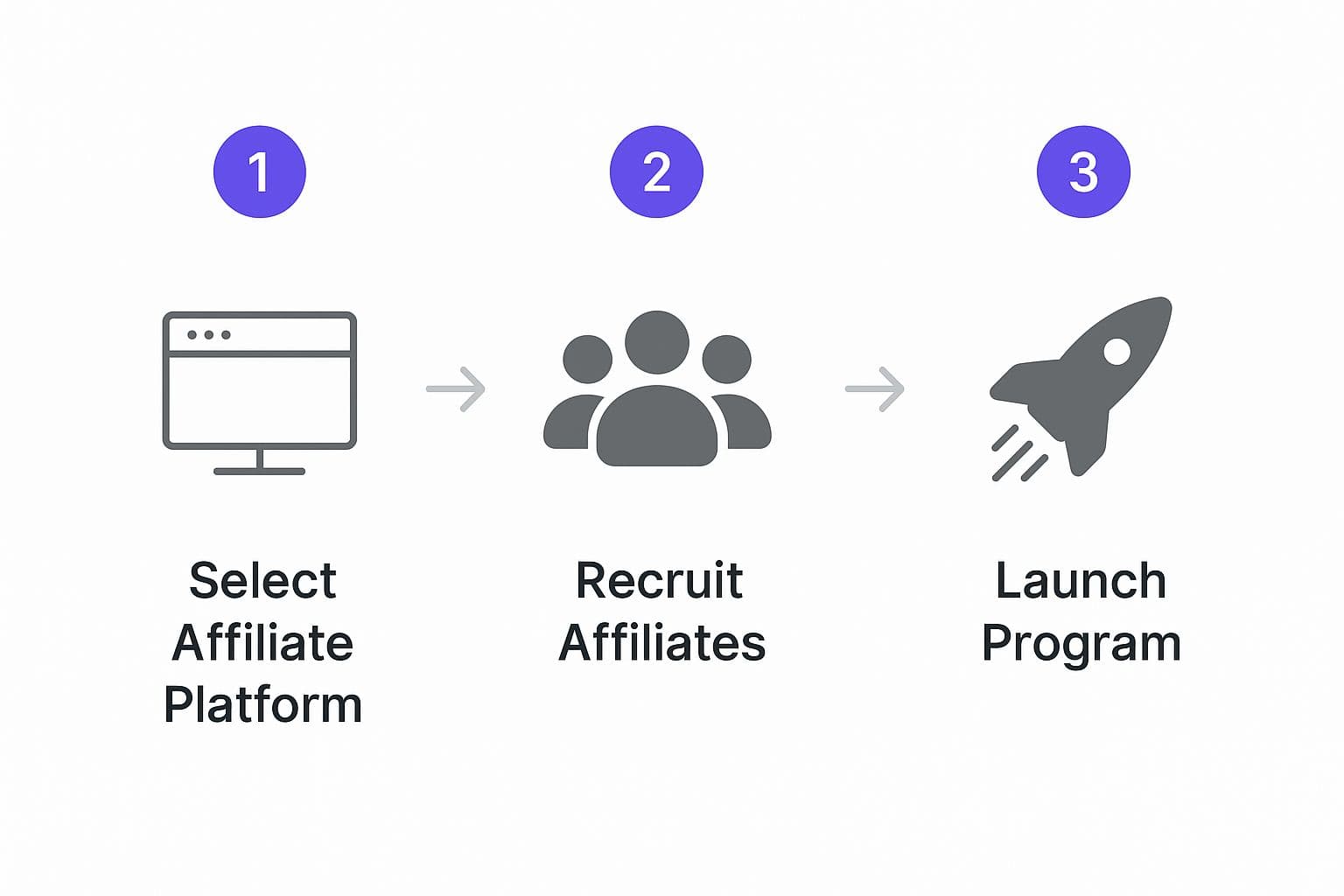
As you can see, it all flows from choosing your tech to finding partners and then hitting the launch button. These are the fundamental building blocks.
So, which path should a startup take? Here’s a breakdown:
| Aspect | Affiliate Network (e.g., Awin) | Self-Hosted Software (e.g., Tapfiliate) |
|---|---|---|
| Upfront Cost | Higher setup fees and monthly minimums (often $500+) | Lower monthly subscription fees (typically $50-$150) |
| Recruitment | Access to a large, built-in pool of affiliates | Requires you to find and recruit your own affiliates |
| Control | Less control over branding and program rules | Full control over your branded portal and terms |
| Management | More hands-off; network handles payments and tracking | More hands-on; you manage relationships and payouts |
For most startups, a self-hosted platform is the smarter play. It’s more budget-friendly and lets you build real, direct relationships with your partners—which is invaluable when you're just starting out.
Crafting a Compelling Commission Structure
With your platform sorted, the next step is to decide on your payment structure. Your commission has to be attractive enough to get affiliates excited but sustainable enough that you don't hurt your profit margins. A bad structure will either attract no one or bleed you dry.
Here are the most common models that work well for startups:
- Cost-Per-Sale (CPS): This is the foundation of affiliate marketing. You pay a percentage of the revenue from a sale they generate. For a SaaS company, offer 20-40% of the first month's subscription. For an e-commerce brand, a 5-30% cut of the order value is standard.
- Cost-Per-Lead (CPL): Here, you pay for an action, not a sale. This is ideal for free trial signups or newsletter subscribers if you have a longer sales cycle. A fintech startup, for instance, might pay $10 for every new user who connects their bank account.
- Tiered Rewards: This model incentivizes top performance. The structure rewards affiliates by increasing their commission rate as they hit specific goals. For example, they might earn 20% on their first 10 sales, 25% from sale 11 to 50, and 30% on every sale after that.
Stop thinking of your commission as just a cost. It's a strategic investment in acquiring a customer. Don't just copy what your competitor is doing. Do the math on your own Customer Lifetime Value (CLV) and what a reasonable Customer Acquisition Cost (CAC) looks like for you. That's how you find a rate that truly fuels growth.
If you want to go deeper on this, our guide on how to start an affiliate program breaks down the financial modeling behind a successful launch.
Equipping Your Affiliates for Success
Your final foundational piece is making it incredibly easy for people to promote you. Top-tier affiliates are busy professionals; if promoting your brand feels like a chore, they'll just move on. Your job is to build them a "welcome kit" of high-quality, ready-to-use assets.
Remember, your partners are marketing experts, not your in-house content team. Giving them polished, ready-to-use materials removes all the friction and keeps your brand looking sharp and consistent everywhere.
Here’s an actionable checklist of must-have assets:
- High-Converting Landing Pages: Don’t just dump affiliate traffic on your homepage. Build dedicated pages for specific campaigns or partner audiences to maximize conversions.
- Compelling Ad Creatives: Create a library of professional banners, social media graphics, and short video clips in all standard sizes.
- Ready-to-Use Swipe Copy: Write effective email templates, social media captions, and ad copy they can grab, tweak, and post in minutes. This is a game-changer.
- Unique Discount Codes: Give affiliates exclusive coupon codes for their audience. This creates urgency and provides a clear reason for their followers to buy now through their link.
By putting real thought into your program's structure and resources, you're not just kicking off another marketing channel. You're building a genuine partnership engine that's ready to scale.
Finding Your First High-Impact Affiliate Partners
You can have the most generous, perfectly structured affiliate program in the world, but it’s worthless without the right people promoting it. The success of your strategy boils down to recruiting that initial group of high-impact partners.
These aren't just accounts with a referral link. They are the trusted voices in your niche who can create genuine buzz around your startup simply by giving you their stamp of approval.
Forget about generic, mass outreach. You need a surgical approach, focusing only on partners whose audience is a dead ringer for your ideal customer. This means going deeper than follower counts to find real influence and engagement.
Identifying Your Ideal Affiliate Profile
Before you can find them, you need a crystal-clear picture of who you're looking for. The best partners usually fall into a few key categories. A smart strategy involves recruiting a mix of them to diversify your reach. The key question to ask is: who already has the ear of my perfect customer?
Your first recruitment push should be focused and strategic. Aim for quality, not quantity.
I'd much rather have five highly relevant, engaged partners than 50 who generate zero meaningful traffic. The 80/20 rule absolutely applies here; a handful of a-players will drive the majority of your results.
So, where do you start looking?
- Niche Bloggers and Content Creators: Find people who have built a loyal following around a specific topic, like SaaS reviews, sustainable fashion, or productivity hacks. Their recommendations carry weight because they’ve spent years earning their audience's trust.
- Existing Brand Advocates: Who already loves your product? Dig through your social media mentions, customer reviews, and support tickets. Passionate users make the best affiliates because their endorsement is authentic.
- Competitor Backlink Analysis: Use an SEO tool to see which websites are linking to your direct competitors. If a respected blog reviewed a similar product, they're a prime candidate to review yours, too.
This proactive discovery is what separates a thriving program from a stagnant one. You’re not just sitting back and waiting for applications; you’re hand-picking your dream team. For a deeper dive, our guide on https://www.referly.so/blog/how-to-recruit-affiliates covers several other powerful discovery methods.
Mastering Personalized Outreach
Once you’ve built a solid list of potential partners, it’s time to reach out. A generic, copy-pasted email will get you deleted in seconds. Your outreach must be personal, concise, and focused on one thing: mutual value. What’s in it for them?
Start by showing you’ve actually done your homework. Mention a specific article they wrote or a recent video they published. This simple step proves you're not a spammer and skyrockets your chances of getting a reply.
Here's an actionable email template that works:
- The Personalized Hook: "Hi [Name], I loved your recent post on [Specific Topic]. Your point about [Specific Detail] really resonated."
- The Quick Intro: "I'm [Your Name] from [Startup Name]. We built [Product Name] to help [Target Audience] solve [Specific Problem]."
- The Value Prop: "Since your audience is focused on [Their Niche], I thought our affiliate program would be a fantastic fit. We offer a [Commission Rate]% commission and provide partners with [Specific Asset, e.g., exclusive discount codes]."
- The Easy CTA: "If you’re interested, you can learn more and sign up here: [Link]. Happy to answer any questions you might have!"
This approach is respectful of their time and gets straight to the point. It’s a conversation starter, not a hard sell.
Creating a Stellar Onboarding Experience
Getting an affiliate to say "yes" is just the beginning. The onboarding process is your single best chance to make them feel valued, empowered, and genuinely excited to promote you. A clunky or confusing start will kill their motivation before they even generate their first click.
Your goal here is to eliminate every single point of friction. Give them everything they need to start promoting effectively from day one. Smooth onboarding transforms an interested partner into an active, revenue-generating advocate.
An effective onboarding experience has three key parts:
- A Digital Welcome Kit: As soon as they sign up, send an automated email with their unique affiliate link, a quick-start guide, and direct links to all your creative assets.
- A Dedicated Resource Hub: Create a simple, easy-to-navigate page on your site that acts as their home base. This should house your logos, banners, pre-written "swipe" copy, product photos, and best practices.
- A Personal Check-In: Within the first week, send a personal email from your affiliate manager. Ask if they have questions and offer to brainstorm initial content ideas. This human touch builds a strong foundation for a profitable, long-term relationship.
How to Keep Your Affiliates Engaged and Motivated
Getting an affiliate to sign up is the starting line, not the finish. The real work—and where most startups drop the ball—is keeping that initial excitement alive. Your ongoing management strategy is where you'll see the biggest returns.
Think of your affiliates as an extension of your marketing team, not just a list of names with referral codes. This mindset shift changes your approach from purely transactional to relational, which is the secret to a program that thrives.
Your goal is to build a community, not just a network. When partners feel like they're part of something bigger, their motivation to perform goes through the roof.
Foster Consistent and Valuable Communication
Silence is the quickest way to kill an affiliate program. If your partners only hear from you at payout time, you're leaving a massive opportunity on the table. Regular, value-packed communication keeps your brand top-of-mind and gives them the fuel they need to keep promoting you effectively.
A monthly affiliate newsletter is a fantastic, low-effort way to do this. But it can't be a generic marketing blast. It has to be a tool built for them.
Here's what to include in your affiliate newsletter:
- Performance Tips: Share actionable insights. For example: "Last month, affiliates who promoted our new X feature saw a 15% higher conversion rate. Here's the exact swipe copy that crushed it."
- Upcoming Promotions: Give them a heads-up on future sales or product launches so they can plan their content in advance.
- Partner Success Stories: Shine a spotlight on a top performer. This provides powerful social proof and gives other affiliates a blueprint for what success looks like.
This proactive communication shows you're invested in their success, which in turn makes them more invested in yours.
Equip Partners with Powerful Tools
Your top affiliates are professionals. They expect professional-grade tools that make their job easier and more effective. Just handing them a referral link and wishing them luck is not a strategy. You need to provide a suite of resources that empowers them to promote your startup with confidence.
Think about the friction points in their workflow. What can you provide that removes those obstacles? The easier you make it for them to succeed, the more they will.
The best affiliate programs don't just ask partners to drive traffic; they give them the keys to a high-performance vehicle. Providing unique coupon codes, deep linking, and real-time data transforms them from simple promoters into strategic growth partners.
Here are three non-negotiable tools:
- Real-Time Performance Dashboards: Affiliates need to see what’s working now. A dashboard showing clicks, conversions, and earnings in real-time allows them to optimize their campaigns on the fly.
- Unique Coupon Codes: This is one of the most powerful tools in your arsenal. A code like "PODCAST15" gives their audience an exclusive incentive and makes tracking easy, even if a user doesn't click the referral link.
- Deep Linking Capabilities: Don't just let them link to your homepage. Give them the ability to create affiliate links to any page on your site—a specific product, a new blog post, or a high-converting landing page. This allows them to create much more targeted and effective promotions.
Incentivize Performance Beyond the Standard Commission
While a solid commission rate is the foundation of your program, it's rarely enough to keep your best partners motivated long-term. Performance-based incentives create excitement and give affiliates concrete goals to strive for, turning passive promotion into active, results-driven marketing.
These extra incentives can be the difference between a good affiliate and a great one. It's all about adding layers to your reward structure that celebrate and encourage exceptional performance.
Consider implementing these types of incentives:
- Commission Bonuses: Offer a cash bonus for hitting specific sales milestones, such as a $250 bonus for reaching 50 sales in a single month.
- Tiered Commission Structures: Automatically bump up an affiliate's commission rate as their performance improves. This creates a built-in ladder for them to climb.
- Friendly Contests: Run a monthly or quarterly contest for the "Top Performer." The prize could be a higher commission rate for the next month, a cash prize, or a bundle of your best products.
By actively managing and motivating your partners, you transform your program from a simple referral system into a dynamic community of brand champions who are genuinely excited to help your startup grow.
Scaling Your Program and Measuring What Matters

Alright, your affiliate program is off the ground and bringing in some consistent wins. Now for the fun part: turning that initial momentum into a real, scalable growth engine. This is the moment you shift from simply managing a program to strategically leading a core revenue channel for your startup.
Smart scaling isn't just about recruiting more affiliates. It's about using data to make calculated decisions, focusing your energy on what works, and building systems that automatically reward top performance. This evolution from manual management to data-driven optimization is what separates a good program from a great one.
And you’re in good company. The global affiliate marketing industry is ballooning, currently valued around $18.5 billion as of 2025 and expected to hit nearly $31.7 billion by 2031. Much of this explosion is fueled by startups finding it to be an incredibly cost-effective way to get new customers, especially with new AI tools making campaigns even sharper. You can dig into more of these stats over on Hostinger.com.
Find and Spoil Your Top Performers
In almost any affiliate program, the 80/20 rule (the Pareto principle) holds true: 20% of your partners will likely drive 80% of your sales. Your first job in scaling is to identify exactly who those people are.
Once you’ve identified them, stop treating them like everyone else. These top performers are your most valuable players, and they deserve VIP treatment. Creating a special, dedicated program for this elite group doesn't just reward them; it builds rock-solid loyalty and pushes them to aim even higher.
A true VIP program is about more than just a commission bump. It's about a genuine partnership.
- Exclusive Access: Let them in on new features or product launches before anyone else. This gives them a head start on creating killer content.
- A Direct Line: Give them a direct contact—you or another key person—for quick help or to bounce around strategic ideas.
- Co-Branded Materials: Offer to create custom landing pages or creatives that feature both your brands. It makes the partnership feel official and boosts their conversion rates.
- Better Payouts: And yes, a higher commission rate or exclusive performance bonuses are a must. They’ve earned it.
This focused attention makes your best partners feel valued, making them far less likely to get poached by a competitor.
Use Tiered Commissions to Motivate Everyone
While a VIP program is great for your current superstars, you need a way to encourage all your affiliates to climb the ladder. This is where tiered commission structures are brilliant. Instead of a single flat rate, you create performance tiers that automatically unlock higher rewards as partners hit certain milestones.
This simple change creates a built-in motivation system. A brand-new affiliate can see a clear path to earning more, while your mid-level partners have a tangible goal to shoot for. It gamifies the process and drives growth without requiring manual management of everyone's motivation.
A well-designed tiered structure turns your commission plan from a simple payment system into a strategic growth lever. It tells your partners, "The more you help us grow, the more we'll share the success with you," which is the foundation of a healthy, scalable partnership.
For a SaaS startup, it might look something like this:
| Tier | Monthly Sales | Commission Rate |
|---|---|---|
| Bronze | 1-10 sales | 20% recurring |
| Silver | 11-25 sales | 25% recurring |
| Gold | 26+ sales | 30% recurring |
The structure is transparent, fair, and incredibly effective at pushing for that next sale across your entire affiliate base.
Measure the Metrics That Actually Matter
As you grow, you need to graduate from tracking basic clicks and sales. To understand the true ROI of your affiliate channel and make smarter optimizations, you have to look at the data that reveals its deeper impact on the business. This is how you prove that affiliate marketing is a central pillar of your growth.
Start focusing on these more advanced metrics to get the full story:
- Affiliate-Driven Customer Lifetime Value (CLV): Are the customers your affiliates bring in actually valuable? Compare the CLV of customers from affiliates to those from your other channels (like paid ads) to see the program's long-term worth.
- New vs. Returning Customer Rate: Is your program finding you brand-new eyeballs, or is it just giving discounts to people who would have bought anyway? A high new customer rate is proof that affiliates are expanding your reach.
- Conversion Rate by Partner Type: Get granular. Do partners who write in-depth blog reviews convert better than coupon sites? Does that influencer on TikTok drive more sales than the one on YouTube? This data is gold for refining your recruitment strategy.
Common Questions About Startup Affiliate Programs
Even the best-laid plans come with questions. When founders dive into the world of affiliate marketing, a few key concerns almost always pop up. Let's walk through the most common ones I hear—getting these answers straight from the beginning will save you a ton of headaches down the road.
First up, the big one: money.
How Much Does It Really Cost to Start an Affiliate Program?
The honest answer is, it depends on the route you take.
If you jump into a big, established affiliate network like Awin, you're looking at setup fees and monthly minimums. These can easily hit $500+ right out of the gate, and that's before you even pay a single commission.
For most startups, a self-hosted approach using dedicated software is a much smarter, more budget-friendly move. Platforms often have plans starting in the $50 to $150 per month range. Yes, it's more hands-on, but your main cost becomes the commissions you pay for actual, tangible sales.
Remember, commissions aren't just an expense; they're a direct investment in acquiring a new customer. The beauty of this model is that your marketing costs scale perfectly with your revenue.
What’s a Realistic Commission Rate for a New Startup?
Setting your commission is a delicate dance between what you can afford and what will actually motivate someone to promote you.
- For physical products: A rate between 5% and 30% is pretty standard, depending heavily on your profit margins.
- For SaaS or digital products: Recurring commissions of 20% to 40% are where you'll be competitive and attract serious partners.
The best place to start? Do a little recon. See what your direct competitors are offering their affiliates. You need to offer a rate that makes a top-tier partner choose you over them, but it also has to be sustainable for your business.
A great strategy I've seen work time and again is a tiered model. Reward your top performers with a higher percentage. It’s a powerful incentive that keeps everyone motivated to send more sales your way.
This is a common point of confusion, and it’s closely related to another popular channel. To see how these commission structures stack up against other models, check out our guide on how to start a referral program.
How Long Until I Actually See Results?
This is where managing your own expectations is critical. While you might get lucky and see your first affiliate sale within a few weeks, building real, predictable momentum usually takes 3 to 6 months.
Think about it from the affiliate's perspective. That initial period is for you to recruit good partners, for them to create authentic content (like blog posts or videos), and for that content to start getting traction and ranking in search engines.
Affiliate marketing is a long game, not a get-rich-quick scheme. The only way to speed up that timeline is through consistent effort in recruiting the right people and actively engaging with them to help them succeed.
Ready to build and scale your own affiliate program without all the complexity? At Referly, we give you the tools to launch a fully branded affiliate portal, automate payouts, and connect with top-tier partners. Book a demo today and see how we can help you build a powerful new revenue channel.
Keep reading
Affiliate Marketing on Facebook: A Practical Guide to Success
Master affiliate marketing on Facebook with our expert strategies. Learn how to create effective campaigns and boost your earnings today!
Mastering Affiliate Marketing Program Management: An Actionable Guide
Unlock success with our guide to affiliate marketing program management. Learn proven, actionable strategies for building, scaling, and optimizing your program.
Affiliate Marketing vs Influencer Marketing: Which Is Better?
Discover the key differences between affiliate marketing vs influencer marketing to choose the best strategy for your business success.